

Almost Everyone Misses The Future Until It Bites You In The Ass
Only the early adopters hit it big - while the rest stand by idly asking the wrong questions


“It must be remembered that there is nothing more difficult to plan, more doubtful of success, nor more dangerous to manage than a new system. For the initiator has the enmity of all who would profit by the preservation of the old institution and merely lukewarm defenders in those who gain by the new ones. ”
Nicollò Machiavelli
“Steve Sasson, an American electrical engineer, invented the first self-contained digital camera while working at Eastman Kodak in 1975.
He developed the prototype using a Super 8 movie camera lens, a Fairchild CCD image sensor with a resolution of 100 × 100 pixels (0.01 megapixels), and recorded images onto a digital cassette tape, a process that took 23 seconds per image.
Although Kodak filed a patent for the invention in 1978 (U.S. Patent 4,131,919) and Sasson was recognized with the National Medal of Technology and Innovation in 2009, the company chose not to commercialize the device, prioritizing its film business.”
The American Inventor
“In 2000, Reed Hastings, the founder of a fledgling company called Netflix, flew to Dallas to propose a partnership to Blockbuster CEO John Antioco and his team.
The idea was that Netflix would run Blockbuster’s brand online and Antioco’s firm would promote Netflix in its stores.
Hastings got laughed out of the room.
We all know what happened next.
Blockbuster went bankrupt in 2010 and Netflix is now a $28 billion dollar company, about ten times what Blockbuster was worth.
Today, Hastings is widely hailed as a genius and Antioco is considered a fool.”
Forbes
“Yahoo! confirmed it reached an agreement to sell its Internet properties to Verizon Communications Inc. (NYSE: VZ) for $4.83 billion.
Back in 1998, two individuals, Larry Page and Sergei Brin, who were unknown to the technology company offered to sell their little startup to AltaVista for $1 million so they can resume their studies at Stanford.
The company that Page and Brin were looking to sell was the soon-to-be patented PageRank system and represents the core of Google (Alphabet Inc).
AltaVista turned down the offer to acquire the company.
Similarly, Yahoo wanted its users to spend more time on its own platform, contrasting PageRank, which sends a user to the most relevant web site.”
Yahoo Finance
About 4 years ago, the Fractal team was criticized that our first two websites were giving away our trade secrets - Fractal enabled quantum speed, on current hardware - via I/O optimization - at scale.
In a chat with a hedge fund manager, our response was we could rent coast-to-coast billboards, showing proof of how if you optimized I/O - input/output - entirely new computing outcomes were possible.
Nobody would believe us.
We had a response - founded in the history - noted above - that the future is ignored, when in plain sight, until events demand it cannot be ignored any longer.
Nobody would believe us because there were millions of SQL/Oracle/Postgres/Amazon AWS techies - with the imagination of a snail - completely invested in 1980s technology stacks - who would stand up and say no such thing was possible.
There were trillions of dollars lining up to build new data centers - which we prove every day are not needed - and those dollars were going to be spent - the future - and the environment - be damned.
Machiavelli, above, is correct - bringing a disruptive technology to market is an almost impossible task.
Almost impossible is not the same as impossible.
It was almost impossible for Netflix - which today is bigger than the Hollywood movie industry.
It was almost impossible for digital imaging - because Eastman Kodak owned the photo film industry - yet today nobody under 30 has likely taken a photo with a film camera.
As Joseph Schumpeter noted almost a century ago, it is innovative disruption that makes those great leaps forward - reinvigorating capitalism - and delivering new outcomes which spawn new business models - creating new industries.
Economic history presents hundreds of examples.
The stirrup, a simple means to stay on a fast moving horse enabled heavily armed warriors - changing battle tactics for 500 years.
The move from oxen to horses pulling a plow revolutionized farming in northern Europe - contributing to over a thousand years of progress from better food-stocks.
There are distinct elements in delivering disruptive technology where mature, obsolete technology persists:
Nobody, or almost nobody, sees disruption until it appears in their rear view mirror.
Disruption doesn’t simply make things different - it enables entirely new economic models which have a downstream impact dwarfing the original innovation.
Disruption is always resisted by those who cannot adapt to it - always. Oracle.
Those delivering disruptive technology have no idea of the scale of the downstream disruption that will follow - although they think they do.
Members of the Fractal team have been present at the birth of other disruptive technologies.
We were in the room when relational database - now a dinosaur - was born.
Team members watched as the COTS (commercial off the shelf software technology) industry was created.
Team members were in attendance shortly after IBM lost its lawsuit with ADR - and the system software industry was born.
The very first email system, sold as an email system was called - EMAIL - by ADR and sold to customers to enable them to communicate within their CICS networks.
When you’ve lived through many technological disruptions - like the first cell phone looking more like a brick than a current phone - you are more sensitive to dismissing a future that may be at hand.
Technology disruption follows a pattern.
There is a roadmap - and it is well traveled - and widely published - here is one example:
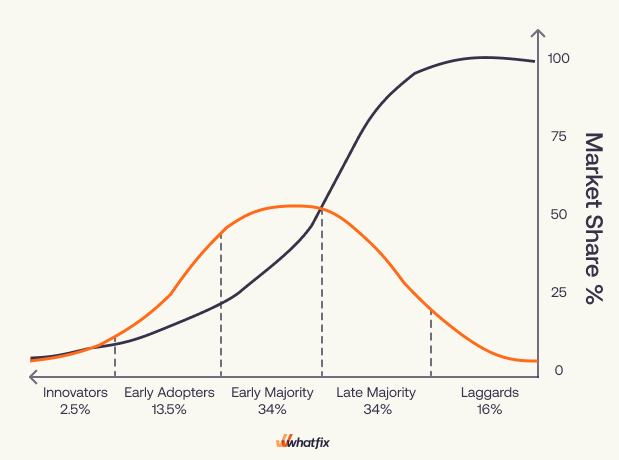
Here at Fractal, we live this journey - focus on the orange line - that is the market for CURRENT technology.
Innovators and early adopters are the ones who are first to use a new technology - usually not because they are looking for technology kicks, but almost always because they are trying to solve a problem current tech cannot solve.
Innovators need quantum speed, today, on current hardware.
Innovators want to deliver an A.I. health care product - against entrenched competitors with huge market shares - at 1/10th the cost and 10x the speed.
Innovators want to deliver war fighting compute - on the battlefield - where no data centers can survive - yet A.I. needs to be used, with lead in the air - to win at combat.
That is Fractal - Land right now.
When we delivered Similarity Search decades ago - it was adopted by eBay because all current fraud technology failed to solve the following problem:
How to find a digital fraudster who changes every attribute - name, address, URL, email, location, credit card, - creating zero commonality between Bill Stevenson and Marie Damato - are they the same person - or not?
Similarity Search can tell you - nothing else comes close.
Neural nets, pattern recognition, relational database - no tech could solve this.
We did.
eBay was no early adopter of unconventional tech - the internet fraud market made them answer our cold calls - number 13 to Meg Whitman - when they called back and said “….never heard of you guys but nobody can stop this - so let’s do a demo.”
Innovators and early adopters have problems that cannot be solved with current technology - period.
So these people look for alternatives - they do not simply quit.
We had calls with several government labs - where they build stuff that kills people - lots of people - enemies of course - and they said they needed to handle combat drones as if they were a flock of birds.
As the chat went on, they said conventional tech could only handle a dozen drones - with no central point of control.
Don’t email me - it is the “no central point of control” that makes this insoluble with current tech. Those videos you see with drones making up a Santa Claus will all fall from the sky if a few of them choke.
The next war, these war fighters envisioned, will have flocks of 10,000 or more combat drones - that need to operate as if they were a single entity - even if every one except that last one is destroyed.
Fractal solved that problem bigly - then we were told by a government agency that our solution will never appear on a public communication forum - as in here - we think that’s a good thing. So let’s move on.
During the same period, the CIO and CTO of one of the world’s biggest shipping companies joined a Zoom call and commented early on that almost every application-related challenge for 30 years concerned I/O.
We showed them how we minimized I/O - and every one of their planes and trucks could have a super computer on board - the size of a pack of cigarettes.
No cloud, no data center, just super compute at extraordinary scale - at a fraction of the cost of conventional tech.
They would never speak with us again.
We learned the CIO spent $245 million building a “cloud native” system - committing that company to large ongoing costs with an I/O intensive infrastructure.
They are what the chart above classifies as a Late Majority or Laggard.
That is not our market - yet.
There are times when a disruptive technology hits the market at the precise moment when a worldwide shift occurs - and these catalyze each other.
Such an intersection creates CRITICAL MASS.
That event is the confluence of the opposing forces in the eternal metaphor:
“When the irresistible force meets the immovable object.”
The force is A.I. and its insatiable demand for data centers everywhere.
The immovable object is the citizen pushback - now prevailing - across America and Europe stopping the environmental devastation caused by data centers.
Data centers are becoming the next asbestos, RoundUp, second hand smoking, drunk driving - they are becoming socially unacceptable because the devastation of many people’s land does not balance with one company’s need to sell A.I.
Politics is downstream from culture it is said - and while the early politicos were all over data centers as the obvious shiny object, they are being challenged by other politicos showing the palpable, visible, destruction data centers cause - without the new jobs promised.
The politicos’ problem is there is no longer a market for this argument:
Why should I give up my beautiful farmland, in the family for 100 years, so a rich guy (Bezos, Elon, Ellison) can buy a bigger yacht?”
Yesterday, there was an answer - well, we have to make room for A.I. because it needs these data centers and if we do not stay ahead of China…..
Fractal and other low I/O software market entrants prove every day, with customers and demonstration projects, there is no application, no A.I. that requires a new data center.
Data centers as the next asbestos is not hyperbole - our team is being called by citizen groups, lawyers and now, electric utility execs - because that immovable object is not going to collapse to that irresistible force.
Citizens are going to win this one - they already are winning.
A constraint entered the system - energy for data centers - and a technology alternative will be demanded, tested, proven - in very public ways.
The market constraints have simply made a low energy alternative inevitable.
Low I/O compute is an alternative - not the only one, but a pretty darn good one - because it’s ready to go now.
This month we took the demonstration project we did with Apple Computer - taking the equivalent of an Oracle Cluster and running it on an Apple Mini - about 6 inches big - and we demonstrate this with environmental and citizen groups - in courtrooms and in public forums.
Fractal can replace Oracle Clusters with Apple Minis.
150 Oracle Clusters in your data center, replaced with 150 Apple Minis, plugged into a wall, running the same stuff, 1,000 times faster, at 1/10th the cost, using less energy than one Tesla, no data center needed - that’s a day that’s at hand.
Data centers are not needed - not beyond the ones already built - America has over 1,000 times the compute power it needs for A.I.
The number is far larger than 1,000 as you will learn when you understand the concept of MESH computing - a Fractal deliverable gaining adherents.
What clever politicians are realizing is they can make the counter argument against their opponents:
“We support sustainable, clean computing, that runs 1,000 times faster, with no data centers, no high power wires through your back yard - at 1/10th the cost using current energy.
We will keep your electric bills low, our opponent wants to raise them with dirty data centers.”
Our website TheSustainableComputingInitiative.com has become a light in the fog of technology doublespeak showing citizens in Virginia, Maryland, California, Pennsylvania, Texas there is an environmentally safe alternative to building data centers.
Fractal technology enables any A.I. or other application to be moved to low I/O tech stacks, in a quarter or less - often in days, seldom in more than 90 days - and it will run without a data center.
It will also run at 1/10th the cost - maybe more when we raise our prices but far less than having your land destroyed for a data center that low I/O tech - from us, from others, from the Chinese too - will render as stranded assets.
Indeed, politics is downstream from culture and the culture war is breaking toward sustainable computing without data centers delivering A.I. to the masses - not controlled by the Tech Bros. with hyperscalers.
As the chart above demonstrates, only about 15% of the population will see it coming - follow Fractal on this Substack so you can be in that 15%.
FractalComputing Substack is a newsletter about the journey of taking a massively disruptive technology to market. We envision a book about our journey so each post is a way to capture some fun events.
Subscribe at FractalComputing.Substack.com
Fractal Website: Fractal-Computing.com
Fractal Utility Site: TheFractalUtility.com
Fractal Government Site: TheFractalGovernment.com
Fractal Sustainable Computing: TheSustainableComputinginitiative.com
@FractalCompute
Portions of our revenue are given to animal rescue charities.
You've gotta laugh at the naysayers commenting on your previous posts. I had some guy comment on one of my previous comments after using Grok to try to disprove what you are saying. GROK? Really. FAFO is all I can say to them
I have no doubt this “data center” hysteria is the newest way to scam tax dollars & private property into the hands of those progressives whom are “smarter than the rest of us”. Typical story of greater power into fewer hands…but all for the ”greater good”!
Nice plan…gather all history’s knowledge, trends & personal preferences in concentrated buildings & ration resources to the “commoners”…what could go wrong?!!!
When is your IPO?!!